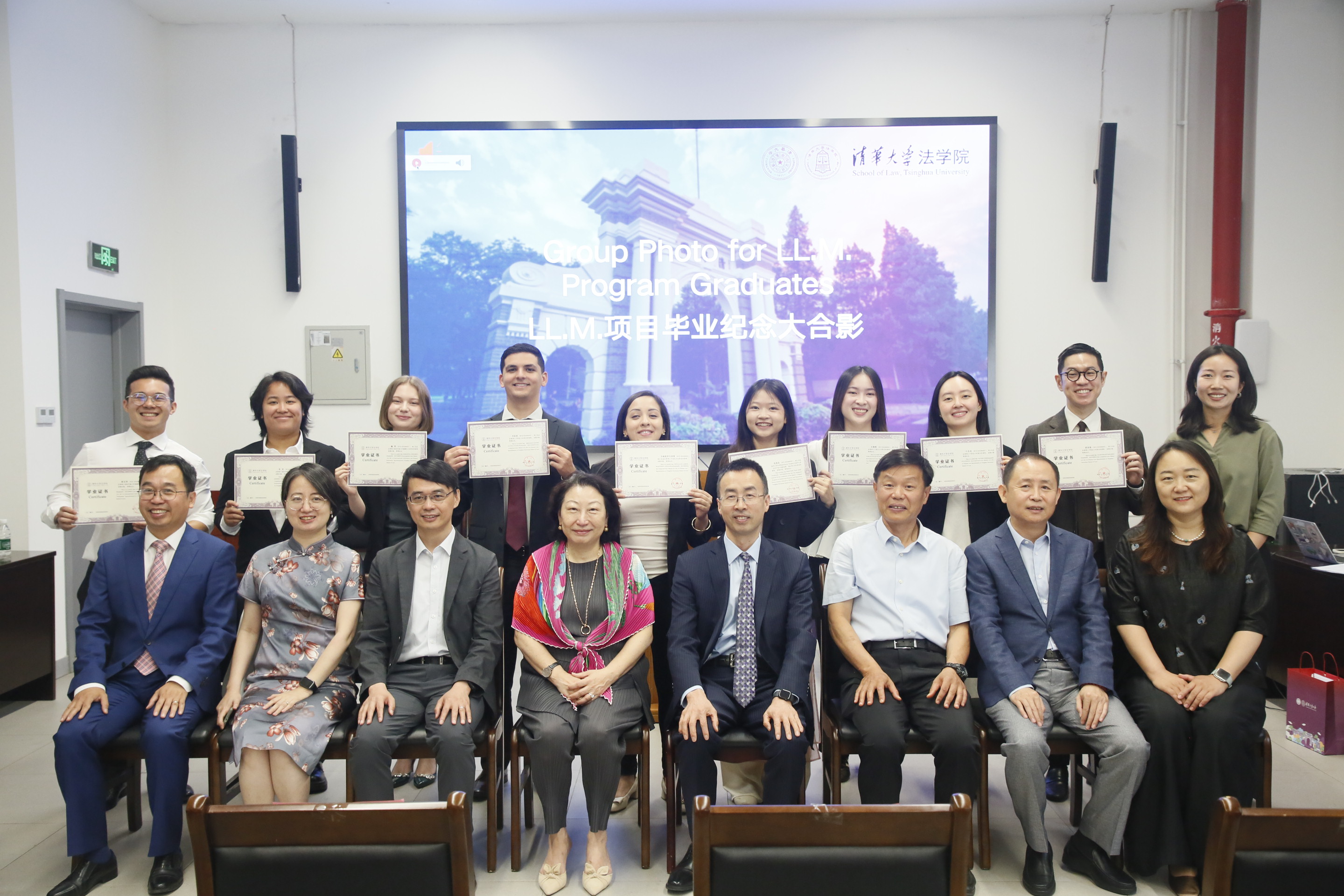
On June 29, 2026, Tsinghua University School of Law held a graduation celebration for the LL.M. (Master of Laws) Class of 2026 in Meeting Room 110 of the Law Library. Thirteen LL.M. students graduated this academic year. Distinguished guests in attendance included Professor Cui Guobin, Dean of the Law School; Professor Chen Hangping, Vice‑Dean in charge of teaching; Professor Gao Simin, Vice Dean for international affairs; LL.M. Programme Directors Professors Teresa Cheng, Chen Weizuo and Chen Xinyu; Associate Professor Zhao Chenguang from Beijing Normal University; and Guo Chen, a lecturer at China University of Political Science and Law.
Professor Chen Xinyu, a faculty member and LL.M. Programme Director, presided over the opening ceremony.
Professor Chen Hangping, Vice‑Dean of the Law School, delivered the opening address on behalf of the School. He reviewed the development of the LL.M. Programme since its launch in 2005. Citing the recent visit of Kim Min‑seok, Prime Minister of the Republic of Korea and an alumnus of the Class of 2010, he highlighted the Programme’s long‑standing international influence. Professor Chen outlined three hopes for the graduates: first, to uphold professional standards of fairness, integrity and prudence; second, to act as ambassadors for the rule of law and foster cross‑border legal cooperation; third, to keep in mind Tsinghua’s motto: “Self‑Discipline and Social Commitment”.
Professor Teresa Cheng, Director of the Master of Law (International Arbitration and Dispute Settlement) Programme, delivered an address. She emphasised the importance of learning how to learn in preparation for future challenges. She urged graduates, whether working in the public or private sector, to act with integrity, uphold professional ethics and respect the rule of law throughout their careers.
Professor Chen Weizuo, Co‑Director of the Master of Law (International Arbitration and Dispute Settlement) Programme and a senior member of the LL.M. Programme faculty, then took the floor. He congratulated the thirteen graduates across the three concentrations on obtaining their Master of Laws degrees, acknowledging their hard work on their thesis proposals and defences. Professor Chen observed that 2026 marks three significant historical milestones: the 20th anniversary of the LL.M. Programme’s first graduating class, the 115th anniversary of Tsinghua University’s founding, and the 90th anniversary of the completion of the Red Army’s Long March. In closing, he encouraged graduates to view the graduation ceremony as a new starting point for their professional lives and to persevere on their own “Long March” through life.
Student representatives Veronika Goreniisa and Vitor Abrahao Castro Alves delivered speeches in turn. They reflected on their academic experiences over the past year, noting that they had gained legal knowledge and formed close friendships. On behalf of all graduates, they expressed gratitude to the School’s faculty and administrative staff.
The ceremony proceeded to the presentation of awards. The Law School established the “LL.M. Programme Outstanding Student” Award in 2024. Veronika Goreniisa received this year’s award, and Professor Chen Weizuo presented her with the certificate.
In recognition of class representatives’ work in supporting their classmates and facilitating communication between faculty and students, the Programme also established a Service Award. Professor Teresa Cheng presented the award to recipients Veronika Goreniisa and Vitor Abrahao Castro Alves.
Professors Chen Hangping and Gao Simin then presented the students with LL.M. Programme certificates and commemorative medallions.
At the close of the ceremony, Professor Cui Guobin, Dean of the Law School, delivered the closing address, offering graduates a “final lesson” at Tsinghua. He recalled legal topics discussed in civil law classes, such as the legal personhood of artificial intelligence systems, property protection for datasets and the legal status of virtual goods, and commended the cross‑cultural perspectives students brought to academic discussions. Drawing on students’ written feedback, the Dean outlined four planned improvements to the LL.M. Programme: first, expanding the teaching team with additional faculty and practitioners to broaden course offerings; second, removing barriers between degree programmes and opening up cross‑programme course enrolment; third, revising admissions criteria for certain concentrations to prioritise applicants with a background in law; fourth, creating more opportunities for interaction between Chinese and international students. He encouraged all graduates to serve as bridges between China and their home countries.
The ceremony concluded with a group photo of all attendees, followed by informal discussions among participants.


 CN
